








Introduction
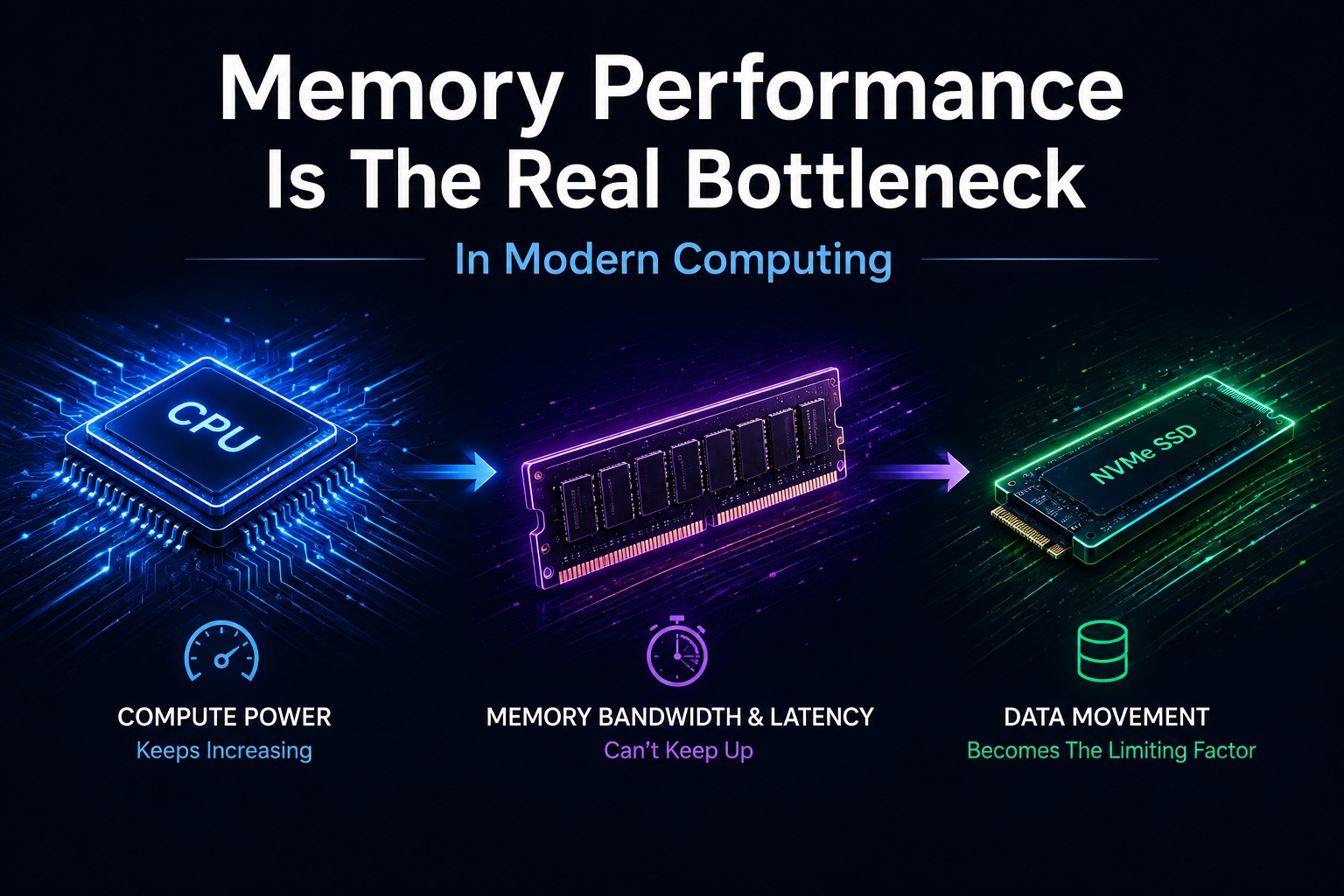
Graphics processing units (GPUs) play an important role in artificial intelligence (AI) development, particularly in deep learning, model training, and inference. When evaluating GPUs for AI workloads, two critical specifications are memory bandwidth and compute power. Although both influence performance, they affect how efficiently a GPU processes data and executes calculations.
Understanding the difference between these specifications helps developers, researchers, and businesses choose suitable hardware for their AI applications. The right balance depends on the model architecture, workload, data movement requirements, and performance objectives.
What Is GPU Memory Bandwidth?
GPU memory bandwidth measures how quickly data can move between a GPU’s memory and its processing units. It is commonly expressed in gigabytes per second (GB/s) or terabytes per second (TB/s).
AI workloads frequently move large amounts of data, including model weights, activations, and intermediate results. If a GPU cannot supply data quickly enough, its processing units may remain underutilized while waiting for information.
High memory bandwidth is particularly valuable for:
1. Large Language Model Inference:
Generating text often requires repeatedly accessing model weights. During batch-size-one inference, memory bandwidth can become a major performance constraint.
2. Memory-Intensive Operations:
Workloads involving frequent data transfers or relatively few calculations per byte can benefit from faster memory access.
3. Large Model Execution:
Models with substantial parameter counts may require significant bandwidth to maintain efficient processing.
However, bandwidth alone does not determine performance. Memory capacity also matters because a model that cannot fit into available GPU memory may require additional memory-management techniques or multiple devices.
What Is GPU Compute Power?
GPU compute power refers to the rate at which a GPU can perform mathematical operations. It is often measured in floating-point operations per second (FLOPS), with specifications varying according to numerical precision, such as FP32, FP16, or supported lower-precision formats.
Modern AI workloads use large numbers of matrix multiplications and other mathematical operations. GPUs with strong compute capabilities can execute these operations efficiently when sufficient data is available.
High compute power is especially useful for:
1. Training Deep Learning Models:
Training involves repeated forward and backward passes that require extensive calculations.
2. Large-Batch Inference:
Processing multiple inputs together can improve hardware utilization and increase throughput.
3. Complex Neural Networks:
Models with computationally intensive operations may benefit from greater processing capacity.
Actual performance depends on more than theoretical FLOPS. Memory access, software optimization, parallelism, and hardware utilization also influence results.
GPU Memory Bandwidth vs Compute Power: Key Differences
The main difference is that memory bandwidth determines how quickly data can be supplied, while compute power determines how quickly calculations can be performed. A GPU with excellent compute capabilities may deliver disappointing results if it spends too much time waiting for data. Similarly, high memory bandwidth cannot fully compensate for insufficient computational capacity when a workload requires extensive mathematical operations.
This distinction is often described through the concept of arithmetic intensity, which measures the number of computational operations performed per byte of data transferred. Low arithmetic intensity can indicate a memory-bound workload, while high arithmetic intensity can indicate a compute-bound workload.
Conclusion
GPU memory bandwidth and compute power are both essential for AI performance, but neither is universally more important. Memory-bound workloads benefit from faster data access, while compute-bound workloads benefit from greater processing capacity.
By understanding workload requirements and testing actual performance, organizations can choose GPUs that deliver better efficiency and value for their AI infrastructure.